Egypt eVisa health requirements in 2026: UK travellers need no special vaccination to apply for an Egypt eVisa, as the online application contains no health questions. Yellow fever certificates are required only if arriving from an endemic country. COVID-19 restrictions are fully lifted. Travel insurance with at least £1 million medical cover is strongly recommended, as the UK GHIC provides no coverage in Egypt.
Published 9 September 2026. Guidance verified against FCDO (gov.uk) and TravelHealthPro (travelhealthpro.org.uk) sources. This is an informational portal; confirm current rules on official government websites before travel.
Health Entry Requirements for Egypt eVisa 2026
Egypt eVisa health requirements mandate yellow fever vaccination exclusively for travellers arriving from WHO-listed risk countries. UK direct flights are exempt. Egyptian border authorities verify vaccination certificates at the point of entry, not during the online application.
Yellow Fever Vaccination Certificate – When Is It Mandatory?
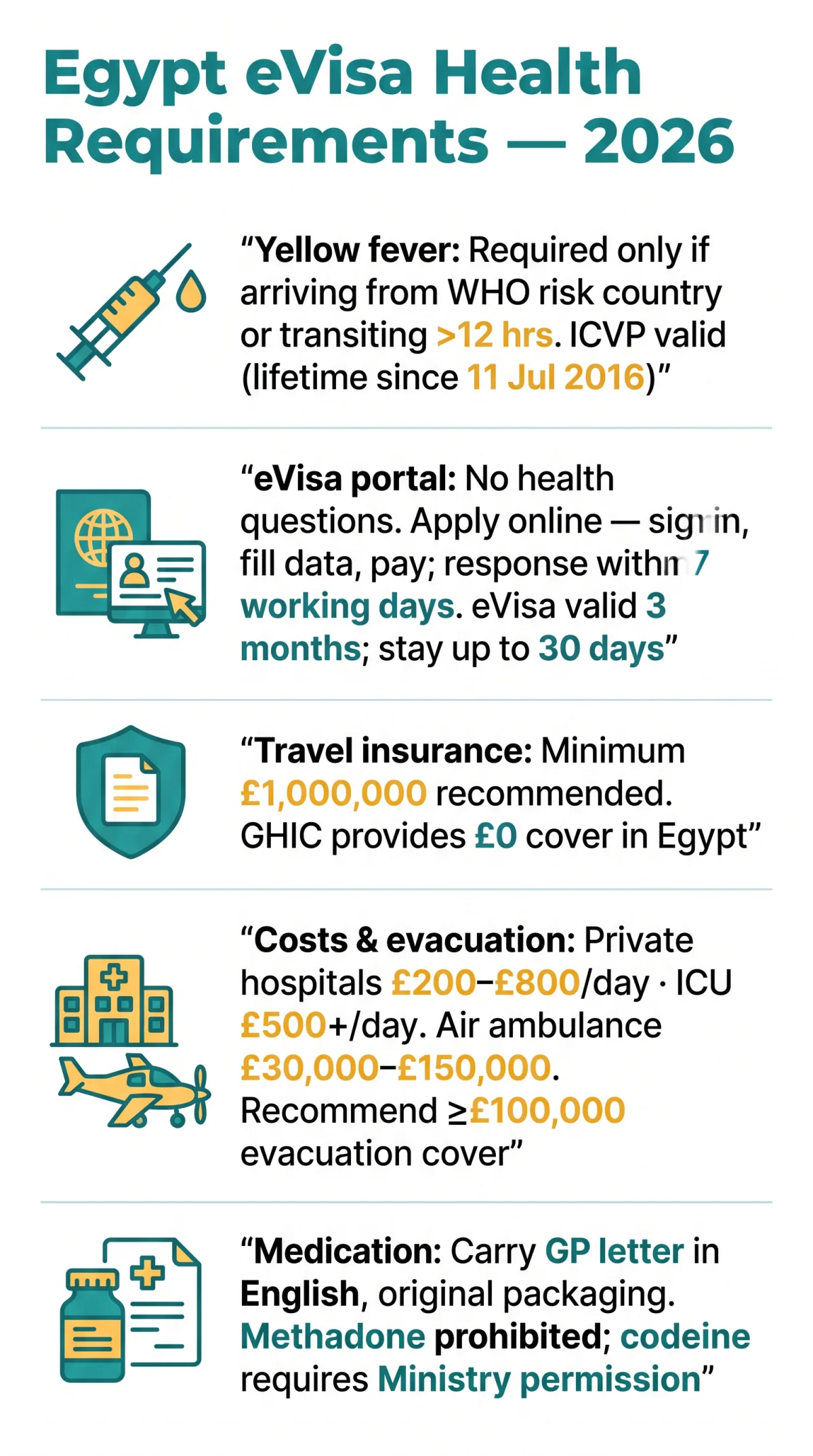
Egypt eVisa health requirements require a valid International Certificate of Vaccination or Prophylaxis (ICVP) for travellers over 9 months of age arriving from a yellow fever-endemic country, or who transited through a risk-country airport for more than 12 hours. The ICVP carries lifetime validity from 11 July 2016; boosters cannot be required. TravelHealthPro confirms Egypt itself carries no yellow fever risk. For the current WHO list of risk countries, visit who.int.
COVID-19 and Other Health Rules in 2026
All COVID-19 entry restrictions are fully lifted in 2026: no testing or vaccination proof required. Polio vaccination proof (Salk vaccine, administered at least 4 weeks before entry, valid 12 months) may apply to travellers from endemic countries. UK tourists are generally exempt. Travellers from Turkey, Lebanon, Libya, or Sudan may require pre-approval clearance 6 to 8 weeks before travel.
| Disease | Mandatory/Recommended | When Required | Notes |
|---|---|---|---|
| Yellow fever | Conditionally mandatory | Arriving from or transiting >12 hrs through risk country | ICVP; lifetime validity from 11 July 2016 |
| Polio | Conditionally mandatory | Travellers from endemic countries | Salk vaccine; 4-week pre-entry deadline; 12-month validity |
| Hepatitis A/B, typhoid, rabies, DTP, MMR | Recommended (routine vaccination) | 4-6 weeks pre-travel GP consultation | Non-mandatory; align with UK routine vaccination schedule |
| Malaria | Not required | All tourist areas | Zero risk in Cairo, Luxor, Aswan, Red Sea resorts |
| Dengue | Preventive measures | Daytime mosquito protection | Risk present in towns and cities |
| Schistosomiasis | Avoidance advisory | Nile and dam freshwater contact | Avoid swimming in fresh water; follow food and water hygiene guidance |
Travellers visiting Sinai resorts (Sharm El-Sheikh, Dahab, Nuweiba, Taba) for less than 15 days receive a free entry permission stamp on arrival, valid only within those resorts.
Does the Egypt eVisa Application Ask About Your Health?
Egypt eVisa health requirements do not involve any medical screening during the online application. The e-visa portal contains zero health disclosure questions. The four-step process (sign in, fill data, online payment, response within 7 working days) collects only personal info, passport details, travel dates, and accommodation. The issued eVisa grants a 3-month entry window and a 30-day maximum stay. Medical requirements are verified separately by Egyptian border control upon arrival.
Egypt eVisa health requirements apply equally regardless of visa type. For travellers who do not apply online, a visa on arrival costs $30 USD (cash only) at physical airport counters. From 1 August 2026, Cairo International Airport digital kiosks offer self-service visas for $36 USD ($30 visa + $6 digital service fee, card payment only).
| Requirement | Tourist eVisa | Work / Residence Permit |
|---|---|---|
| Health disclosure fields | None | Medical examination required |
| HIV test | Not required for tourism of any duration | Mandatory |
| Vaccination certificates | Checked at border, not in portal | Submitted with application |
The FCDO advises UK travellers to check current health regulations at gov.uk/foreign-travel-advice/egypt before departure.
Travel Insurance Recommendations for Egypt 2026
Egypt eVisa health requirements recommend private travel health insurance for all UK visitors. The UK GHIC is valid only in EEA countries and Switzerland: zero coverage in Egypt. Industry minimum: £1m to £5m private medical cover.
Why Your GHIC Does Not Cover Egypt
GHIC/EHIC provides £0 in Egypt. Standard policies exclude pre-existing conditions in >40°C heat, hyperbaric chamber treatment, and routine dental work. Undeclared pre-existing conditions void the policy entirely.
Medical Evacuation & Repatriation Cover
An air ambulance from the Red Sea to the UK typically costs £30,000 to £150,000. Private hospital stays in Egypt range from £200 to £800 per day, with private ICU care exceeding £500 per day. Egypt eVisa health requirements recommend policies with at least £100,000 in medical evacuation and repatriation cover, plus 24/7 helpline access, direct hospital payment, and trip cancellation protection.
Diving Insurance & Pre-Existing Conditions
Scuba diving treatment in hyperbaric chambers is excluded by standard travel health insurance policies; a specialist diving add-on is essential for Red Sea trips. Travellers with chronic conditions must declare them at purchase, as extreme heat above 40°C can trigger exclusions. Over-60s may face age surcharges.
| Cover Type | Minimum Recommended | Why It Matters | Typical Cost If Uninsured |
|---|---|---|---|
| Medical treatment | £1,000,000-£5,000,000 | Private hospitals require upfront payment | £200-£800/day |
| Medical evacuation/repatriation | £100,000+ | Air ambulance Red Sea to UK | £30,000-£150,000 |
| ICU care | Included in medical cover | Private ICU rates in Egypt | £500+/day |
| Scuba diving treatment | Specialist diving add-on | Hyperbaric chambers excluded by standard policies | Variable |
Disclaimer: Some insurance links may be affiliate links. We only recommend policies that meet the £1m minimum cover for Egypt.
Medication Import Rules & Pre-Travel Health Checklist
Egypt eVisa health requirements stipulate that prescription medication entering Egypt requires an English-language GP letter stating drug name, dosage, and medical necessity. Methadone is strictly prohibited.
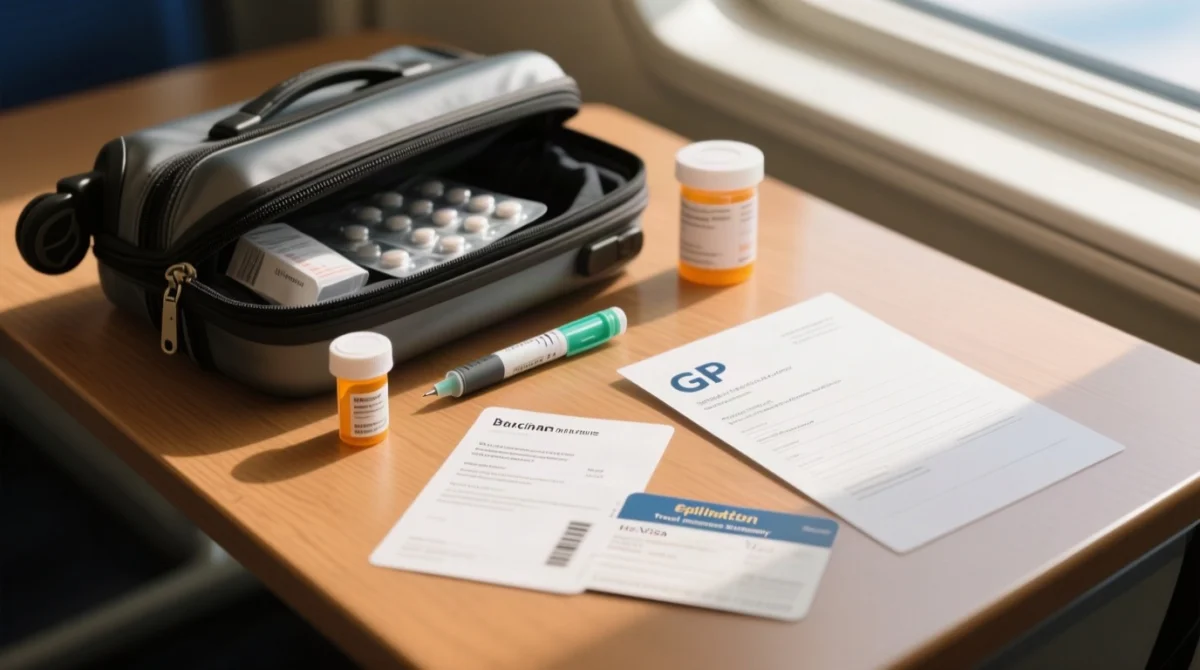
- Codeine-based OTC medications require prior permission from the Egyptian Ministry of Health.
- Keep all medication in original pharmacy packaging with visible labels.
- Medical devices (CPAP, insulin pens, EpiPens): carry a prescription copy; needles and sharps must go in carry-on with a doctor’s letter.
- For medication import enquiries, contact the Egyptian Medical Office in London at the Egyptian Consulate, 2 Lowndes Street, Belgravia, London SW1X 9ET (tel: +44 (0)20 7235 9777).
- Customs declaration: declare foreign currency exceeding $10,000 USD; local currency limit is 5,000 Egyptian pounds.
Week 6
GP appointment for routine vaccination updates (hepatitis A/B, typhoid) and medication letter.
Week 4
Obtain yellow fever certificate if transiting an endemic country; purchase travel insurance with minimum £1m medical cover.
Week 2
Pack medication in original packaging; verify insurance covers planned activities.
Week 1
Download eVisa confirmation; print insurance policy summary.
Day of travel
Carry vaccination certificate, insurance documents, and medication in hand luggage.
FAQ: Egypt eVisa Health Requirements 2026
Do I need a yellow fever vaccine to enter Egypt from the UK in 2026?
No. Mandatory only if arriving from a WHO-listed risk country. UK direct flights are exempt. Carry ICVP if transiting through an endemic country for more than 12 hours.
Does the Egypt eVisa application require any health information?
No. The e-visa portal contains zero health disclosure questions. Medical requirements are verified separately by Egyptian border control upon arrival.
Is travel insurance compulsory for an Egypt eVisa?
Not required to obtain the eVisa, but essential. GHIC provides £0 cover in Egypt and FCDO recommends £1m+ medical cover.
What vaccinations are recommended for Egypt in 2026?
Hepatitis A, B, typhoid, DTP booster, rabies for extended stays, and routine vaccination updates. Consult GP 4 to 6 weeks before departure. No antimalarials needed.
Does my GHIC cover me for healthcare in Egypt?
No. GHIC and EHIC are valid only in EEA countries and Switzerland. Private travel health insurance is essential.
What happens if I need medical treatment in Egypt without insurance?
You are fully liable. Private hospitals cost £200 to £800/day, ICU £500+/day, air ambulance to the UK £30,000 to £150,000.
Can I bring prescription medication into Egypt on my eVisa trip?
Yes, with a GP letter in English specifying drug name, dosage, and medical condition. Keep in original packaging. Methadone is prohibited; codeine requires Ministry of Health permission.
Is there a malaria risk for tourists visiting Egypt in 2026?
No. Zero malaria risk in tourist areas including Cairo, Luxor, Aswan, Red Sea resorts, and the Nile Valley. Antimalarials are not required.
Do I need travel insurance to get an Egypt eVisa?
No. Insurance is not required to apply for or receive an eVisa, but it is essential for travel safety in Egypt.
What health documents should I carry at Egypt border control?
ICVP if arriving from a yellow fever risk country; GP letter for prescription medications; travel insurance policy summary. Passport must have 6 months validity and 1 blank page.